
The Whole Self
Victor Wembanyama is not just the best player in the NBA. He might be exactly what it needed.

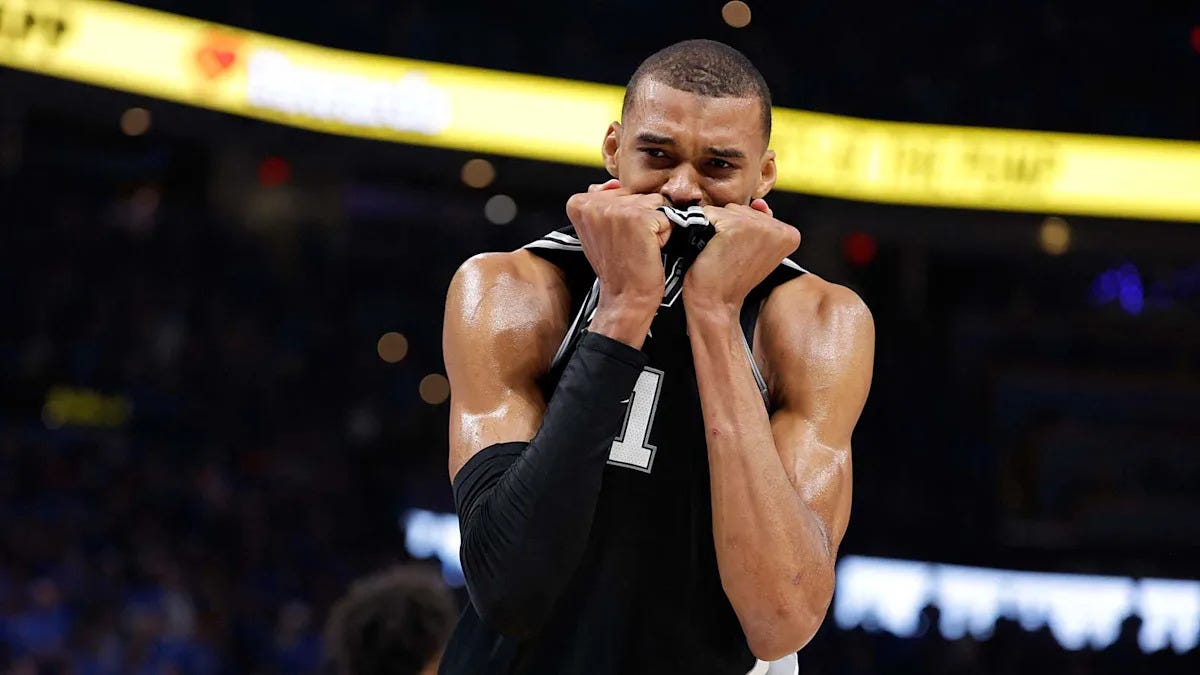
As Devin Vassell threw down the exclamation point with just 4.1 seconds remaining in Game 7 of the Western Conference Finals, Victor Wembanyama folded his 8-foot wingspan in half, grabbed the lining of his jersey and nearly ripped it apart as the clock finally hit zero with the San Antonio Spurs winning 111-103 to secure a trip to the NBA Finals against the Knicks. For two minutes, Wemby moved between screaming at the floor, breaking down into tears and circling in front of the Spurs bench, hugging teammates and letting out the occasional euphoric yell. Then he found his father, Félix, on the floor of Paycom Center in Oklahoma City and held him.
“It’s hard to put into words,” he told reporters afterward. “It’s almost like the meaning of my life.”
He’s still just 22 years old.
When asked about Gregg Popovich — who stepped down as the head coach of the Spurs in May 2025 after 29 seasons — Wembanyama paused, fighting against more tears for his first NBA coach. “I don’t know what it means for him,” he said. “He goes through some things we can’t even imagine. So, I need to call him. I need to see him. I need to talk to him because there’s no way I can understand right now how he feels.”
What’s special about Wembanyama — outside of the obvious — is that this is truly how he is. He’s not a brand, not a product but a person. A person who the NBA should be thanking their lucky stars they got.
For most of its history, the NBA has been producing stars who feel and present themselves more like corporations. Their image, managed, carefully messaged and socially present without getting too honest. Michael Jordan sold shoes like no one else, but was never one for speaking out despite calls to do so. LeBron James followed suit, building an empire that made him basketball’s first active player to become a billionaire. Steph Curry has made himself into a lifestyle brand. Even lower on the popularity totem than that, many players have tried to protect their personas like a trademark, operating under the assumption of more followers, but few feelings.
Either Wembanyama didn’t get the memo, or he threw it away.
Following the Spurs eliminating the Portland Trail Blazers in the first round, French journalist Maxime Aubin of L’Équipe asked him about fans who mock his tears, saying he should stop crying and trying to attack his manhood. His answer was simple: “That’s a tough question. I think it’s first and foremost a fear of judgment. Like this feeling that you have to act a certain way, social codes, I guess. Personally, I refuse to carry the burden of having to hide my emotions.”
That quote acts as a thesis for who he is as a man. This isn’t something that was produced on his behalf or required by his circumstances. This is who he is, a personal philosophy built and defended in a league that for as long as it’s been around has awarded stoicism and denounced any form of “softness.” But Wemby challenges that argument, saying that showing what you feel isn’t a sign of weakness — it’s honesty and a testament to how much the game means to him. And for a generation of young men that will grow up watching him, that argument extends beyond the confines of basketball.
The emotional openness extends beyond the boundaries of Frost Bank Center or wherever else the Spurs play that night. It’s a larger quality that shows up whenever there’s a microphone pointed at the young star.
On Jan. 27, 2026, following a Spurs practice, Wembanyama was asked about the killings of U.S. citizens Renée Good and Alex Pretti at the hands of federal agents during an ICE operation in Minneapolis. But before opening up about his thoughts, he mentioned the business that surrounds him and his refusal to suppress his true feelings on the matter.
“PR has tried, but I’m not going to sit here and give some politically correct answer,” he said. “Every day I wake up and see the news, and I’m horrified. I think it’s crazy that some people might make it seem like the murder of civilians is acceptable.”
He carried on, naming his own limits to the media attending the practice.
“I read the news and sometimes I’m asking very deep questions about my own life. But I’m conscious also that saying everything that’s on my mind would have a cost that’s too great for me right now.” Asked directly whether his hesitation came from not being American, he was straightforward: “For sure. Yeah.”
That ability to speak with conviction while also acknowledging what he’s choosing to withhold is what makes his thoughts strike a chord with so many who both watch the game and witness the horrifying images happening in this country, like me. He’s not a megaphone, but a person speaking carefully and intelligently in real time and telling you what he’s found through his own lived experience. It’s not unheard of from an athlete to take this approach — take Jaylen Brown, for example — but to do it at his young age, in a position of ascension to the top ranks of popularity in an increasingly popular league, makes his voice carry that much more weight than a less selective one.
To understand his approach to addressing sensitive matters such as the Minneapolis killings, you have to have an idea of just who he is when nobody’s asking him anything.
Ahead of the 2025-26 season, Wembanyama spent 10 days at the Shaolin Temple in Zhengzhou, China. Head shaved and shoulders draped in traditional Buddhist monk robes, waking up at 4:30 a.m. for kung fu and Chan meditation out of public view (despite all the stories emerging following his sighting last summer). Following a game against the Brooklyn Nets the night before, Wemby sent out a tweet the next morning inviting strangers to meet him and play chess. He draws aliens, now becoming his signature logo with Nike — including adding one to Nikola Jokić’s jersey on request and the sole of his own pair of Nikes. He reads obsessively, enough so that in the midst of the Spurs’ Finals run this May, the San Antonio Public Library launched a “Read Like Wemby” campaign around his science-fiction favorites, with nearly 160 copies checked out or placed on hold within days. Veteran teammate Harrison Barnes started a Spurs book club with him that eventually whittled down to just the two of them.

“Everything that you hear about Vic is true,” teammate De’Aaron Fox said to NBC after their Game 4 win over OKC. “He don’t wanna see blue light after 9 o’clock. He reads books. He’s not on his phone.”
Wemby is no saint when it comes to facing the onslaught of media that meet him after every game. After a poor loss in Game 5 to OKC that put the defending champs one game away from making their second consecutive trip to the Finals, Wembanyama skipped mandatory postgame media entirely, drawing a warning from the league. On May 10, he was ejected for a Flagrant 2 after throwing a nasty elbow to the face of Minnesota’s Naz Reid, his first career ejection. NBC’s broadcast caught him mouthing “hard foul” to reserves before they delivered hard contact on Jared McCain. The edge is real, and it isn’t always clean.
That edge is in no way a contradiction of everything else; it’s living proof of it. A brand-managed superstar doesn’t give you the tears amid the celebration at Paycom Center, nor the elbow. The same player who wept for Popovich, who called the murder of civilians in Minneapolis unacceptable, who shows up to chess games in Washington Square Park — that player competes with a fury that many others fail to match, that occasionally spills over. He is not performing wholesomeness. He is showing you all of it and letting you decide what to make of it.
As Len Werle of OpenCourt Basketball wrote, Wembanyama isn’t just reshaping what a big man can do on the court — he is reshaping what a superstar is allowed to feel.
The NBA has spent decades creating stars who decided early that the safest version of themselves was the most valuable one. Victor Wembanyama has made a different calculation — that the full version is the only one worth being. He cries when it hurts. He speaks when it matters and tells you when he can’t. He reads, draws, meditates and shows up whole.
And a generation of young men is watching him do it — learning, maybe for the first time from someone at his level, that none of that makes you less. It makes you more.